If you’re trying to beat urban traffic or exploring weekend trails, you’ve likely faced the classic dilemma: should you get an electric bike or an electric motorcycle?
At first glance, both get you from point A to point B without burning gas. But once you factor in registration paperwork, license requirements, maintenance costs, and where you can actually ride, the gap between them widens quickly.
While electric motorcycles promise high speed, they come with the heavy baggage of traditional motor vehicles. High-performance electric bikes, on the other hand, offer comparable power and range while retaining the freedom, portability, and agility of a bicycle. Let’s look at why more riders are skipping the motorcycle dealership and choosing modern e-bikes instead.
Freedom from Red Tape: Licenses, Insurance, and Street Rules
The biggest headache of owning an electric motorcycle isn’t the price—it’s the bureaucracy. Because they are classified as motor vehicles, you need:
- A valid motorcycle license or endorsement.
- Mandatory vehicle registration and license plates.
- Ongoing monthly insurance payments.
- strict adherence to motor vehicle traffic lanes (no bike paths or trail access).
E-bikes completely bypass these friction points. In most regions, high-performance e-bikes are legally treated as bicycles. You don’t need to stand in line at the DMV, pay annual registration fees, or lock yourself into an insurance policy. You simply get on and ride.
More importantly, e-bikes give you route flexibility. When city streets gridlock, e-bike riders can utilize dedicated bike lanes, park pathways, and shortcut trails that motor vehicles simply aren’t allowed to touch.
Portability and Storage: Try Fitting a Motorcycle in Your Trunk
Unless you have a garage and a dedicated trailer, storing and transporting an electric motorcycle is a nightmare. They often weigh upwards of 200 to 300 pounds, making them impossible to haul without specialized equipment.
Modern e-bikes solve this mobility puzzle through intelligent engineering and folding designs.
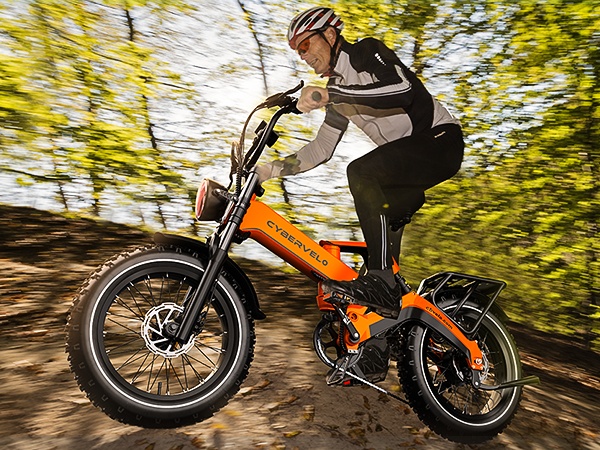
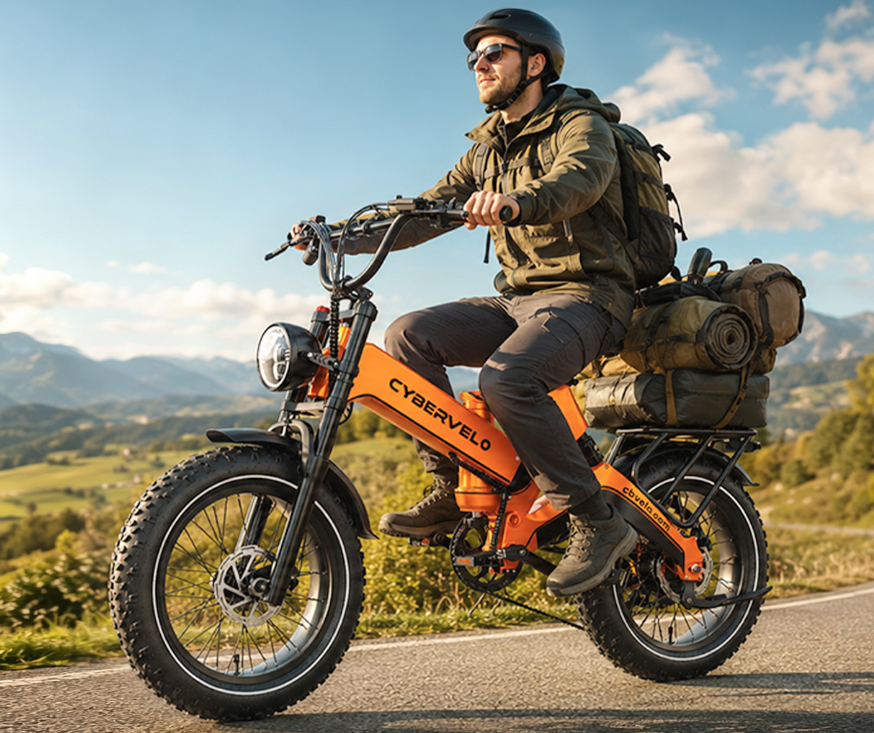
Take the Cybervelo EK6 MAX as an example. Built on a lightweight magnesium alloy frame with a foldable mechanism, it collapses easily to fit inside an SUV trunk or an apartment closet. Yet, it doesn’t sacrifice raw performance:
- Power & Speed: A 1500W high-speed motor pushing up to 40 MPH.
- Massive Battery: A 48V 40AH battery delivering an impressive max range of up to 120 miles.
- Traction & Comfort: 20×4.0 puncture-resistant fat tires with reflective strips, paired with a full dual suspension system and premium hydraulic disc brakes for rough terrain.
- Control: A precision Shimano M315 8-speed trigger shifter and an advanced LCD display to monitor your ride metrics.
For those who need extreme utility on a compact footprint, models like the Cybervelo MARS700 offer a lightweight high carbon steel foldable frame. Equipped with a 1000W motor, 28 MPH top speed, 48V 20AH battery (up to 80 miles range), plush wider seat cushions, and front/rear basket mounts, it serves as an ideal daily cargo runner that takes up zero garage space.
Performance Without the Weight Penalty
A common misconception is that e-bikes are slow compared to electric motorcycles. While standard commuter e-bikes are modest, high-output category models bridge the speed gap entirely for urban and off-road riding.
Consider the Cybervelo EK9. It blurs the line between e-bike versatility and raw motorcycle power:
- Extreme Output: A massive 5000W motor generating 120 N·m of torque, allowing rapid acceleration and a top speed of 50 MPH.
- Long-Distance Capacity: Powered by a 60V 50AH battery yielding up to 120 miles of range.
- Heavy-Duty Chassis: Wrapped in a durable aluminum alloy frame with 26 x 4.0 fat tires, a large color dashboard, and a dual crown suspension fork featuring lockout and adjustment.
- Stopping Power: High-end TEKTRO and Logan 203mm hydraulic disc brakes to handle high-speed stops smoothly.
The EK9 gives you motorcycle-class thrill and speed, but retains the physical agility, lower weight, and overall lower operating costs of an e-bike.
Total Cost of Ownership: Fueling, Repairs, and Maintenance
Maintaining an electric motorcycle requires specialized mechanic visits, expensive replacement parts, and costly tire swaps.
- bikes are engineered with standard, accessible bicycle architecture. Components like mechanical/hydraulic brake pads, Shimano gear shifters, and standard fat tires can be easily serviced at home or by any local bike shop. You save thousands over the vehicle’s lifespan on labor, routine maintenance, and registration renewals alone.
The Verdict: Which One Fits Your Lifestyle?
While electric motorcycles have their place on highway commutes, high-performance electric bikes offer the ultimate balance for modern riders. You get near-motorcycle speeds and extended ranges, backed by the freedom to ride in bike lanes, easy storage options, and zero DMV headaches.
If you want a versatile machine that folds into your life rather than taking over your garage, a premium performance e-bike is the smarter, more economical investment.